
Our Location
304 North Cardinal St.
Dorchester Center, MA 02124

A practical comparison of airtight and vacuum coffee canisters without unsupported freshness promises.
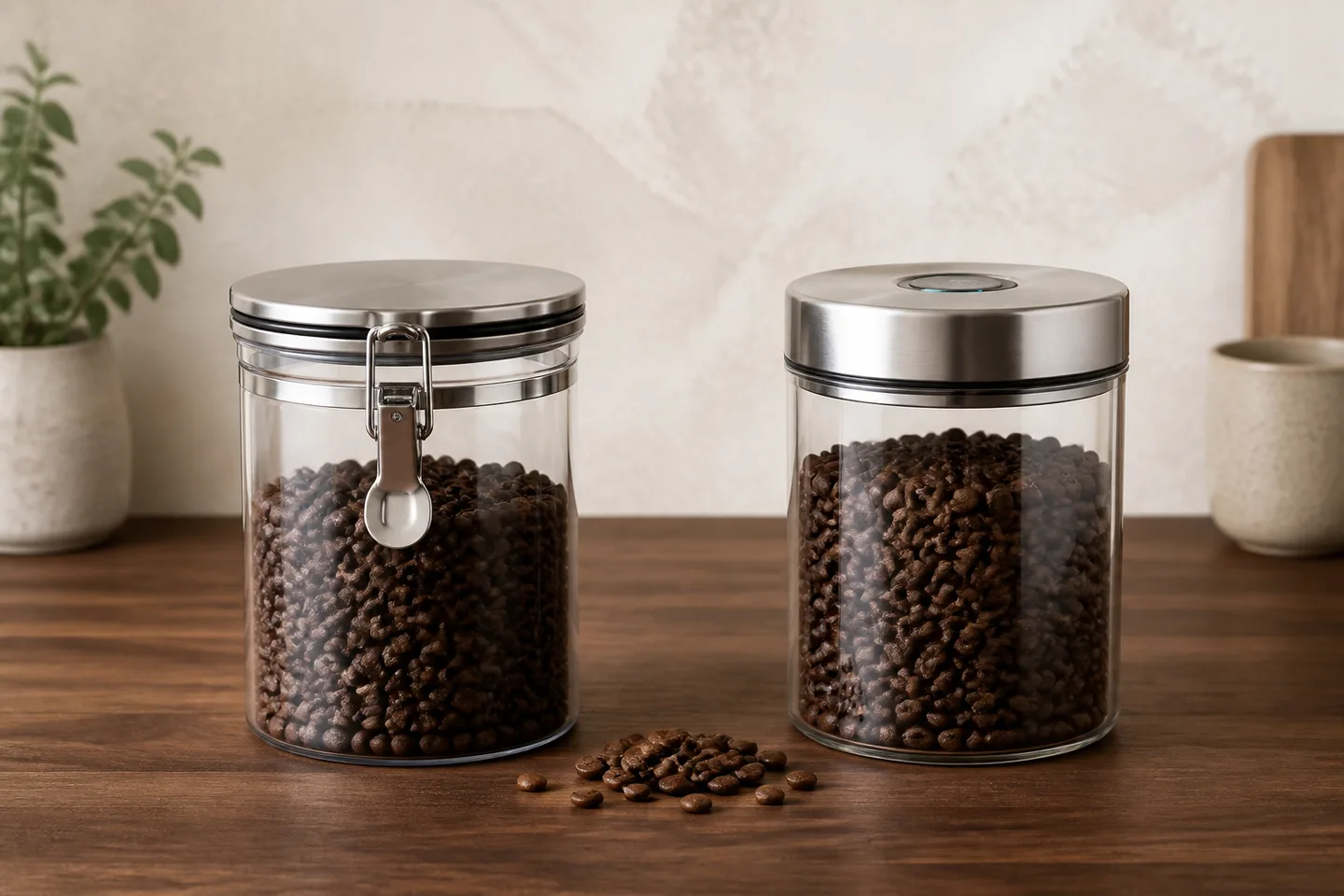
An airtight coffee canister is designed to limit air exchange after the lid is closed. A vacuum coffee canister also removes some of the air from inside the closed container. Both approaches can support good storage, but neither replaces a cool location, dry handling, fresh purchasing, and a container size matched to your routine.
The better choice is the one you can close correctly every day and use without creating extra exposure or inconvenience.
An airtight canister uses a gasket, clamp, threaded lid, or similar closure to reduce air moving between the container and the room. Once closed, the air already inside remains with the coffee unless pressure or temperature changes move it through the seal.
Advantages of a simple airtight design include:
• Few operating steps
• No battery, pump, or charging requirement
• Easy visual confirmation that the lid is closed
• A wide range of sizes and materials
The main limitation is headspace. As you use the beans, the empty volume above them grows. Each time the lid opens, room air enters before the container is closed again.
A vacuum canister removes some internal air after closing. Depending on the design, this may happen with a manual pump, a twist mechanism, or an electric system. “Vacuum” in a consumer coffee canister does not mean the container reaches a perfect vacuum or contains zero oxygen.
Potential benefits include:
• A repeatable step that reduces internal air after closing
• A seal or status indicator on some models
• Less dependence on the remaining bean volume for reducing headspace air
Potential tradeoffs include:
• More steps or components
• A seal that must stay clean and undamaged
• Charging or batteries for electric models
• The need to release pressure before opening
Do not assume that the word “vacuum” proves a specific freshness extension. A numeric performance claim requires testing of that exact product under defined conditions.
Question: Limits room-air exchange when closed
Airtight canister: Yes, with a sound seal
Vacuum canister: Yes, with a sound seal
Question: Removes some internal air
Airtight canister: No
Vacuum canister: Yes
Question: Requires an operating step
Airtight canister: Usually just close the lid
Vacuum canister: Pump, twist, or automatic cycle
Question: Requires power
Airtight canister: No
Vacuum canister: Only for electric designs
Question: Needs seal maintenance
Airtight canister: Yes
Vacuum canister: Yes
Question: Stops coffee from aging
Airtight canister: No
Vacuum canister: No
Question: Works best in a cool, dark place
Airtight canister: Yes
Vacuum canister: Yes
Oxygen is important, but it is not the only factor. Coffee also changes with moisture, temperature, time, grinding, and repeated handling. The Specialty Coffee Association’s review of staling research notes that even coffee stored under vacuum or low oxygen can still undergo oxidation.
That is why the following habits matter with either container:
• Keep the container away from sunlight, heat, and steam.
• Use clean, dry tools.
• Grind only the amount you need when practical.
• Avoid buying more open coffee than your household can manage.
• Close or reseal the container promptly.
Start with the full coffee-bean storage guide if you are building your routine from scratch.
A 2022 study compared four ways consumers handled opened whole-bean coffee: transferring beans to an airtight canister, closing the original package with tape, using a clip, and using a package with an integrated screw cap. In that test, the integrated screw-cap package best protected the measured aroma indicators.
That result is useful, but it is not proof that every bag beats every canister. The study tested particular packages and handling methods, measured chemical freshness indicators, and noted that sensory work was still needed. It did not test Flowcat, every airtight container, or every vacuum design.
The practical lesson is broader: closure quality and the way a package is opened and closed can materially affect the environment around the beans.
• You want the fewest possible steps.
• You finish a modest amount of coffee consistently.
• You prefer a fully mechanical container.
• You are confident you will close the lid correctly every time.
• You want to reduce internal air after each closing.
• You value a vacuum or freshness-status indicator.
• You rotate between coffees and want a more deliberate storage routine.
• You do not mind maintaining the seal and operating mechanism.
• It has a strong barrier and a reliable closure.
• You can press out excess air and reseal it consistently.
• You will use the coffee soon.
• Moving the coffee would add handling without solving a real problem.
When comparing containers, check the details behind the label:
1. Seal design: Is it easy to clean, inspect, and replace if needed?
2. Material: Is the food-contact surface suitable for repeated coffee storage?
3. Light control: Is the body opaque, or will you store it in a cabinet?
4. Capacity: Does it match your usual bag size and consumption?
5. Opening: Can you fill and measure beans without a mess?
6. Status feedback: Can you tell whether the lid or vacuum cycle is complete?
7. Maintenance: Are the cleaning and charging steps realistic for you?
Flowcat’s Smart Coffee Preservation Canister combines automatic vacuum sealing, freshness tracking, and USB-C charging. It is intended to make the close-and-seal step more repeatable for everyday countertop or pantry use.
The product should be evaluated on those documented features, available sizes, material options, ease of cleaning, and fit with your household—not on an unsupported promise that any container can preserve every coffee for a fixed number of days.
No. A vacuum mechanism addresses internal air, but seal quality, opening frequency, temperature, moisture, container size, and user habits still matter. A well-used simple container can be a better choice than a more complex container used incorrectly.
No. It limits exchange with outside air after closing, but the headspace still contains air. Some containers use displacement or vacuum mechanisms to reduce that headspace air.
Roasted coffee releases carbon dioxide after roasting. Follow the roaster’s rest guidance and the container manufacturer’s instructions. Do not improvise with a container that is not designed for the intended use.
Yes, if the bag fits without interfering with the seal. This can retain the bag’s label and reduce cleanup. It may also use space inefficiently, so compare it with transferring the beans into a clean, dry container.
• National Coffee Association: Storage and shelf life
• Specialty Coffee Association: What is the shelf life of roasted coffee?
